

Pass the Bar Exam. Full Stop.
The truth about the bar exam nobody teaches in law school.

The bar exam is not an IQ test. It is a performance test. And yet, most law students prepare for it incorrectly.
Every year, intelligent, capable law graduates walk into the California, New York, and Uniform Bar Exams carrying enough stress, caffeine, outlines, flashcards, and existential dread to power a small nation. Many fail. Often, most fail. Not because they lack intelligence. Not because they lack discipline. And certainly not because they are incapable of becoming great lawyers.
They fail because nobody taught them how the game actually works.
Read that 2x.
Law school rewards one set of skills. The bar exam rewards another. One rewards discussion, theory, and academic exploration. The other rewards structure, execution, timing, pattern recognition, and the ability to perform under extreme pressure with your career on the line.
That distinction changes everything.
Over the past twenty-six years as an entertainment attorney, law professor, and legal educator, I have worked with law students, lawyers, producers, executives, writers, and entrepreneurs across the United States and internationally. Along the way, I developed a system for approaching the bar exam that rejects panic, burnout, doom-scrolling, and the absurd mythology surrounding bar prep culture.
The goal is not to suffer.
The goal is to take the bar exam once, PASS, and be done with it.
Efficiently. Strategically. Confidently.
My system became a series of books covering the California Bar Exam, the New York Bar Exam, and the Uniform Bar Exam, which now covers almost the entire United States except Louisiana and a handful of other jurisdictions that maintain unique testing structures based upon ancient French law and.
But this was never about outlines alone. It was about building a repeatable performance system capable of producing results under pressure.
You do not need to become miserable to become a lawyer.
You need a plan. And you need to compete.

The Humbling.
At the peak of my music career, I was one of the best rudimental drummers in the world. I had a Drum Corps International championship ring, multiple high percussion trophies, endorsements from Pearl Drums and Zildjian Cymbals, and my own signature drumstick on the market. In 1994, I became the Percussion Director of the Santa Clara Vanguard, one of the most legendary drum and bugle corps in history.
I thought I had life figured out.
Then, once upon a time in February 1995, after rehearsal in San Jose, I survived a carjacking and shooting incident that made the newspapers and forced me to reevaluate everything. Almost overnight, my identity shifted. I decided to go to law school, despite knowing zero about the legal profession.
Forty-eight hours after returning from the Drum Corps International tour in New York, I was sitting in the back row of a crowded lecture hall at the University of San Francisco School of Law. And I was lost. I remember hearing the word “plaintiff” and realizing I had no idea what the professor was talking about. Not figuratively. Literally.
True story.
And it got worse from there.
Despite an extreme work ethic, I struggled badly during my first semester. I studied constantly. I outlined obsessively. I treated law school like NFL training camp. And when grades came out, I was staring at a transcript full of Cs.
WTF? That moment changed my life.
Because for the first time, I realized that hard work alone was not enough. Something had to change, because I had no more hours in any given day to give to law school.
And I realized that law school and the bar exam were not rewarding the same skills that had turned me into a world-class drummer. I was approaching the problem incorrectly, using brute force where strategy and structure mattered more.
That epiphany became the foundation of everything that followed.
The Breakthrough
After my first semester at USF, I became obsessed with one question:
How could someone work that hard and still perform at an average level?
I was doing everything law students are told to do. Reading endlessly. Highlighting everything. Rewriting notes. Living in the library. Sacrificing sleep. Sacrificing balance. Sacrificing sanity. Yet none of it was producing elite results.
Eventually, I realized the problem was not effort.
The problem was strategy.
Law school and the bar exam are strange intellectual competitions because they create the illusion that more information and more hours studying automatically produce better performance. They do not. At a certain point, overload becomes the enemy. The human brain cannot operate efficiently in a constant state of panic, exhaustion, distraction, and information saturation.
I had shown up to a football game carrying a baseball glove.
Everything changed when I stopped trying to memorize every microscopic detail of every case and started focusing on performance. I began studying the structure of legal analysis instead of drowning in legal trivia. I started identifying answer patterns on multiple-choice questions. I became obsessed with timing, execution, retention, and mental control under pressure.
Most importantly, I started protecting my time aggressively.
That became the foundation of what I later called Time Wall Theory.
The results were dramatic.
My grades improved. Then they improved again. Eventually, I earned straight As in subjects Constitutional Law, Property, Contracts, and Entertainment Law. I later passed the California Bar Exam on my first try and began teaching law students myself.
But the biggest breakthrough was philosophical.
I realized the bar exam was beatable.
Not through misery. Not through panic. Not through genius-level IQ.
Through structure, discipline, repetition, confidence, and strategic execution under pressure.
The Truth About the Bar Exam
The bar exam has developed a mythology of its own.
People talk about the bar like it’s a psychological apocalypse. They disappear for months. They stop sleeping. They stop exercising. They stop acting like human beings. Entire industries profit from convincing intelligent law graduates that they are one missed kooky flashcard away from professional ruin.
Much of this is bullshit.
The bar exam is hard, but it is not mystical. It is not measuring your value as a human, your future potential, or your IQ. It is measuring whether you can consistently execute under pressure inside a highly structured testing environment.
That is a very different thing.
One of the biggest mistakes applicants make is confusing activity with progress.
You spend 12 hours a day “studying” while retaining almost zero because your brain is exhausted and fragmented. You bounce between outlines, lectures, social media, group chats, Reddit threads, and panic spirals until the entire process becomes emotionally radioactive.
That fails.
The shiny happy people who pass the bar are not screaming about how hard they are working. They are building repeatable systems and executing them consistently every day. It’s easier than you think.
The same principle applies to multiple-choice questions. Most applicants approach them “bass ackwards.”
They obsess over obscure legal rules while ignoring answer pattern recognition, timing, and strategic elimination techniques. The highest-performing applicants eventually stop “translating” every question intellectually and start recognizing patterns. That only comes through repetition and disciplined execution.
The essay portion is no different. The graders are not searching for literary brilliance. They want organization, legal reasoning, issue recognition, and structured analysis. Your job is not to impress the grader. Your job is to make the grader’s life easy.
And contrary to the mythology surrounding bar prep culture, misery is not required for high performance.
In fact, chronic stress, sleep deprivation, panic, and burnout are some of the greatest threats to passing the exam. Your brain performs better when your life has structure, balance, and control. Confidence is not a personality trait in this environment. It is a competitive advantage.
That realization became the foundation of System 7.
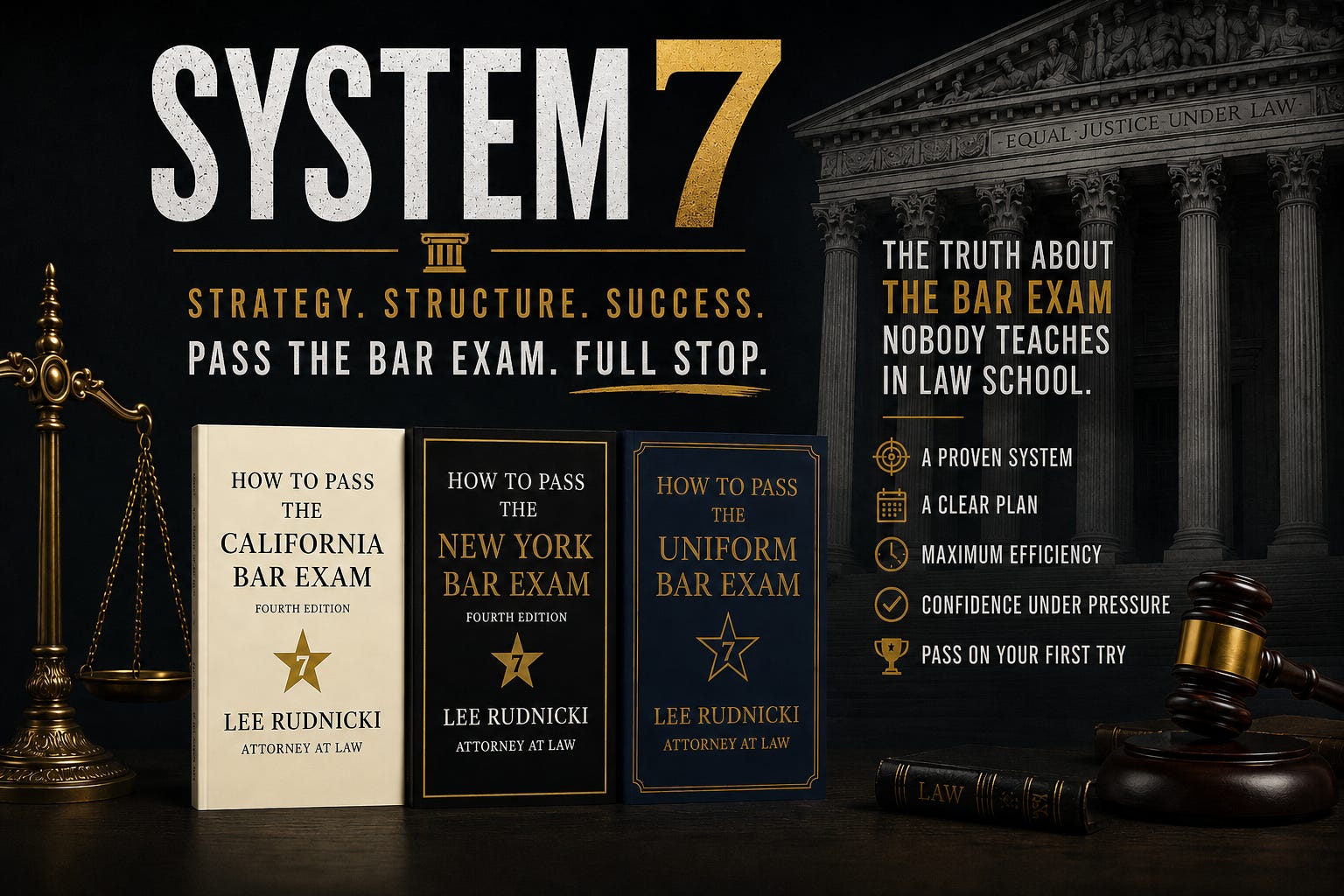
System 7
System 7 was not created in a laboratory, a focus group, or a marketing meeting.
It was built under pressure.
The system emerged from failure, adjustment, competition, and years of teaching students preparing for one of the hardest professional licensing exams in the world. Over time, I refined the concepts that consistently produced results and eliminated the ones that created stress, confusion, and wasted motion.
The core philosophy is simple: control what matters and eliminate what does not.
Protect your time. Build structure. Develop answer pattern recognition. Train active recall. Stop confusing panic with productivity. Study with intensity, then disconnect completely and recover. Compete with discipline instead of emotion.
My approach became a series of books covering the California Bar Exam, the New York Bar Exam, and the Uniform Bar Exam, which together now cover almost the entire United States bar exam landscape minus a few jurisdictions with legal codes based upon ancient French law and legal principles that may or may not involve pirates.
My books are not “read and hope” materials sitting untouched on a shelf beside a dying highlighter and an energy drink. They were built as tactical systems designed to change how you approach the exam itself.
That distinction matters.
Most bar prep advice focuses almost entirely on information.
System 7 focuses on performance. The difference is not subtle.
The truth is that many applicants already have enough raw intelligence to pass before bar prep even starts. What they lack is structure, efficiency, confidence, and a sustainable system capable of carrying them through months of preparation without mental collapse.
That is the gap System 7 was designed to fill.
Compete!
If you are preparing for the bar exam right now, understand something important:
You are far more capable than you think.
The fear surrounding this exam has become so amplified that many applicants walk into the process already defeated. They speak about the bar as if it were an impending natural disaster rather than a professional challenge that can be systematically and easily conquered through preparation and execution.
The doom-and-gloom mindset must go.
You do not need to become a genius. You do not need to study twenty hours a day. You do not need to destroy your health, abandon your personality, or disappear into a dungeon filled with flashcards and despair to pass.
You need structure.
You need discipline.
You need a system.
And above all, you need to compete.
The bar exam rewards applicants who stay focused, stay calm, and continue executing when everyone else begins spiraling emotionally. That is where the real separation occurs. Not intelligence. Not drama. Execution.
That is why I wrote these books.
To build a practical system for passing the California Bar Exam, the New York Bar Exam, or the Uniform Bar Exam. A system built from real pressure, real failure, real adjustment, and ultimately, real success.
Because the bar exam is beatable.
Not for “gifted” people.
Not for people who enjoy performative suffering on social media.
Not for the people screaming the loudest about how impossible everything is.
For disciplined people.
For focused people.
For people willing to build a system and execute it under pressure.
That is why I wrote these books.
If you are taking the California Bar Exam, the New York Bar Exam, or the Uniform Bar Exam, stop wandering through the chaos collecting random advice from stressed-out strangers on the internet. Build a real plan. Protect your time. Learn the game. Compete with confidence.
You already survived law school.
Now finish the mission.
Pass the bar exam. Full stop.
Click on a book cover below to view it on Amazon.


